
*Overview of the Green Economics Institute*

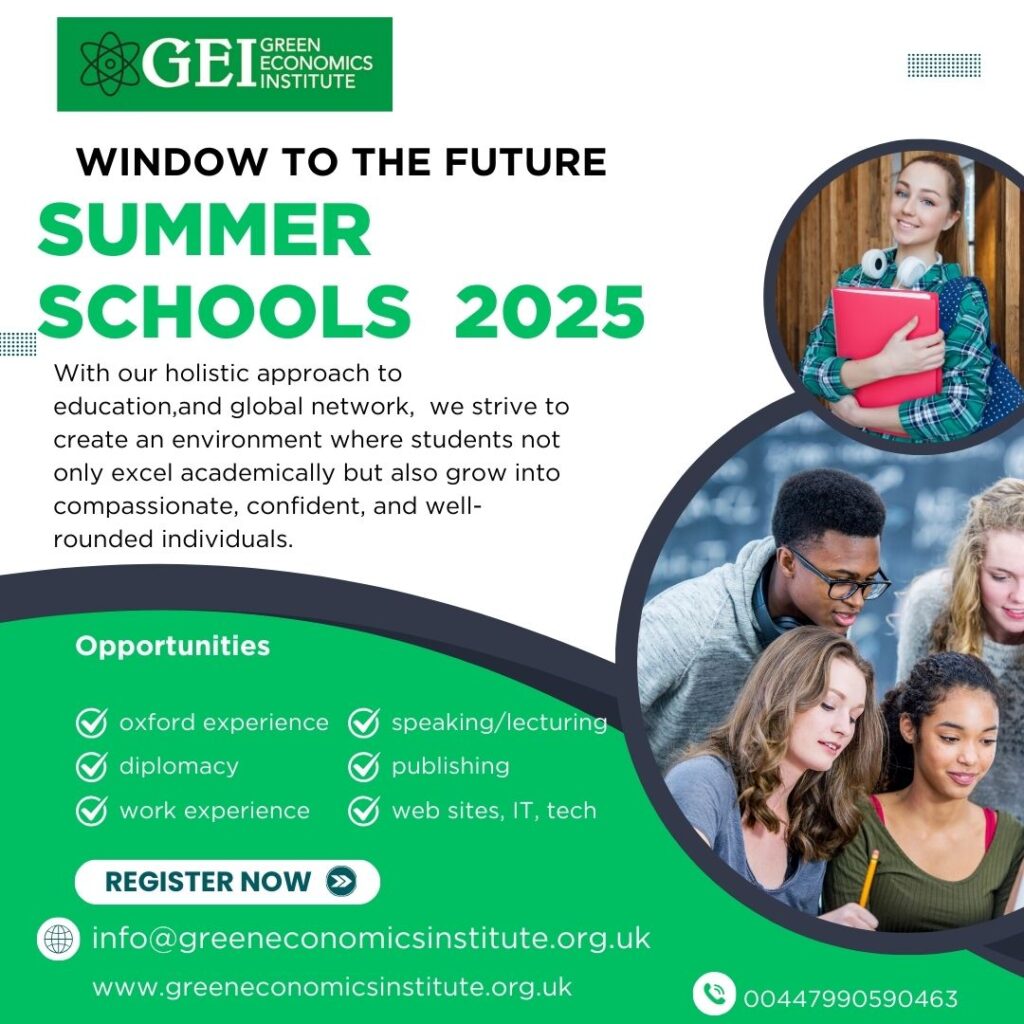

The Green Economics Institute (GEI) was founded in 2003 as an international institute for “green economics professionals, green economics, green jobs and green careers.”
*Its mission:* to promote ecological, social and economic justice; to reform mainstream economics toward sustainability, inclusion, and justice; to address climate change, biodiversity loss, inequality, and reconstruct an economy that serves people, nature, and the planet.
It operates globally via a network of academics, researchers, activists, students, professionals.
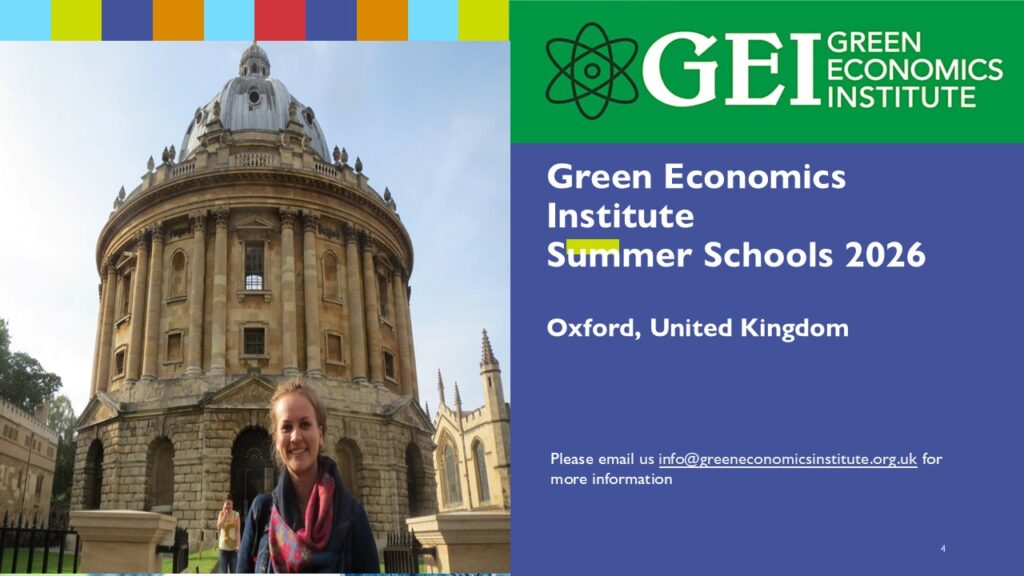
Summer School, Course no 4 Week 4 24th -28th August 2026
GEI is more than a think-tank: it runs education and training programs; a publishing house; an academic journal; conferences; internships; field-trips; and various events — aiming to build capacity for “green economics” worldwide.

Educational Activities in 2026
The 2026 “Education” and “Events & Activities” include the following educational programmes and activities will take place this year.
🎓 Programme Offerings & Opportunities
Internships, Work Placements, Visiting Scholars, Students Programmes
GEI is recruiting for 2026 “study placements, traineeships, publishing traineeships, charity-work, volunteers, work placement and Interns and Visiting Scholars and students of all ages and backgrounds.”
These programmes provide real-world experience: administrative work, event & conference organisation, policy research, writing & publishing, fundraising, volunteering, and more.
Pathways include working remotely (tele-internship or distance), or in-person placements, depending on candidate background and circumstances.
*Academic and Research Training* GEI offers opportunities for postgraduate, post-doc, and visiting-scholar research. Scholars can contribute reports, policy statements, research papers; some will be published under the Institute’s publishing arm.
Interns and students may also participate in academic publishing — contributing to books, chapters, academic articles, and the Institute’s own peer-reviewed journal. There are also short courses / training modules, including “1-day courses,” short-term workshops, and (when possible) longer courses.
GEI proposes (or is developing) more formalised educational pathways: undergraduate, master’s, and PhD programmes — though some remain “in development.”
*Continuous Professional Development & Certification*
GEI offers professional qualification courses: e.g. “GE Green Economist (GEI)” or “M.GEI — Member of the Green Economics Institute” designations following certain courses or exams.
Course formats are flexible: remote study, work-based placements, short intensive courses (during conferences), or longer periods.
Participants receive certificates, feedback, and — if needed — references for their universities or employers.
*Publishing & Academic Output*
GEI maintains a publishing house with over 100 titles (books, academic proceedings, papers).
Its unique world leading double blind peer-reviewed academic journal (the International Journal of Green Economics) provides a platform for scholarly articles, research results, and academic debate in the field of green economics.
Educational participants (interns, students, scholars) are encouraged and often given opportunities to publish — either standalone books, chapters, or journal articles, sometimes in collaboration with senior scholars.

*Conferences, Workshops, Events, Webinars, Field-Trips*
GEI’s calendar for 2026 shows a robust events schedule — including conferences, workshops, panel debates, member evenings, webinars, field trips, virtual tours.
Through these events, students / interns / members get practical exposure: participating in panels, presenting research, networking, engaging in activism and policy dialogues.
This helps tie academic study and research with practical activism and real-world policy engagement — reinforcing GEI’s mission of combining economics, ecology, social justice and activism.

*Remote / Distance Education & Global Participation**
Recognising global membership (75% outside the UK), GEI offers remote/distance education, remote internships, remote placements — enabling people worldwide to engage with its programmes as well as in person routes.
This approach reduces carbon footprint (less travel), increases accessibility, and aligns with the Institute’s green and inclusive ethos.
*2026 Strategic Priorities & Educational Goals (Inferred)*
GEI’s educational strategy in 2026 emphasizes:
Expanding access and inclusivity: by offering remote/distance education, remote internships, and welcoming participants from diverse backgrounds and geographies.
Bridging academic theory and practical activism: through conferences, internships, event organisation, policy-oriented research, media (journal, TV station) — not just teaching in abstract.
Capacity building in “green economics” globally: educating new generations (students, interns, scholars) to adopt sustainable, socially just, ecological economics — building a cadre of green economists, activists, policymakers, researchers, communicators.
Producing output and visibility: via publications (books, journal articles), public events, media, policy interventions — ensuring that academic work leads to real-world impact.
Flexibility and user-centred design: offering variety in programmes (short courses, long courses, internships, remote or on-site, publishing-focused, admin-focused, research-focused), to cater to different backgrounds, life-circumstances, and goals.
Dr. Ehtesham Abbasi.
PhD (Accounting), Master of Finance & Control
Assistant Professor of Accounting, School of Business Administration, Al Akhawayn University, Ifrane, Morocco